
The repair vs. replace flooring decision comes down to the 50% rule: if repair costs exceed half of replacement costs, replacement typically makes more financial sense. Solid hardwood is the exception—refinishing can reset it to like-new condition at a fraction of replacement cost. But tile spot repairs, carpet patching, and laminate fixes have real limitations. The honest question isn’t just “can this be fixed?” It’s “should this be fixed, and will the fix last?” We find Austin homeowners waste money when they repair surface damage without addressing structural problems underneath.
Quick Facts:
- The 50% Rule: If repair costs exceed 50% of replacement, replacement usually delivers better long-term value
- Hardwood Refinishing: Can be refinished 3-7 times; truly resets flooring to like-new condition
- Tile Repairs: Individual tiles replaceable with matching extras; grout can be restored but won’t match aged grout perfectly
- What Fails: Cosmetic fixes over structural problems, refinishing water-damaged hardwood, sealing cracked grout without addressing movement
- Experience: Family-owned Austin flooring experts with honest repair assessments
Top 4 Repair Decisions:
- Hardwood Refinishing – Surface scratches, worn finish, and traffic patterns respond exceptionally well; proper hardwood care extends time between refinishes
- Tile Spot Repairs – Works when damage is isolated and you have matching tiles; widespread cracking indicates subfloor issues requiring replacement
- Water Damage – If cleaned within 24-48 hours without warping, refinishing may work; cupped or crowned boards typically need replacement
- High-Value Rooms – Kitchen and bathroom flooring takes serious abuse; consider whether repair holds up to continued wear or if a more durable material makes sense
Ready to Choose? Contact Soleil Floors for honest advice on whether repair or replacement makes sense for your situation.
The repair vs. replace decision comes down to three factors: what caused the damage, how extensive it is, and what it will cost to fix compared to starting fresh. There’s no universal answer because a repair that makes perfect sense in one situation wastes money in another.
Here’s my honest take: most flooring repairs that homeowners attempt end up being partial solutions to larger problems. The repair “works” for a while, then the same issue comes back—or spreads. That’s not because repairs are bad, but because the real question isn’t “can this be fixed?” It’s “should this be fixed, and will the fix last?”
Table of Contents
When Does Repairing Flooring Make Financial Sense?
Let’s start with the math, because that’s usually what drives the decision.
The 50% rule is a good starting point. If repair costs exceed 50% of replacement costs, replacement typically makes more sense. You’re paying half the price for a partial solution that won’t reset the clock on your floor’s lifespan. At that point, new flooring gives you better long-term value.
But that calculation isn’t always straightforward. Consider these factors:
What are you actually comparing? Repair costs need to include the full scope—not just fixing the visible damage, but addressing any underlying issues. Replacement costs include tear-out, subfloor prep, new materials, and installation. Get real quotes for both before deciding.
What’s the expected outcome? A repaired floor that looks 80% as good as new might be perfectly acceptable. Or it might bother you every time you walk through the room. Be honest about whether you’ll be satisfied with the repair result.
How long do you plan to stay? If you’re selling in 2 years, a good repair might be all you need. If this is your forever home, investing in replacement may provide decades of additional enjoyment.

What Repairs Actually Work Long-Term?
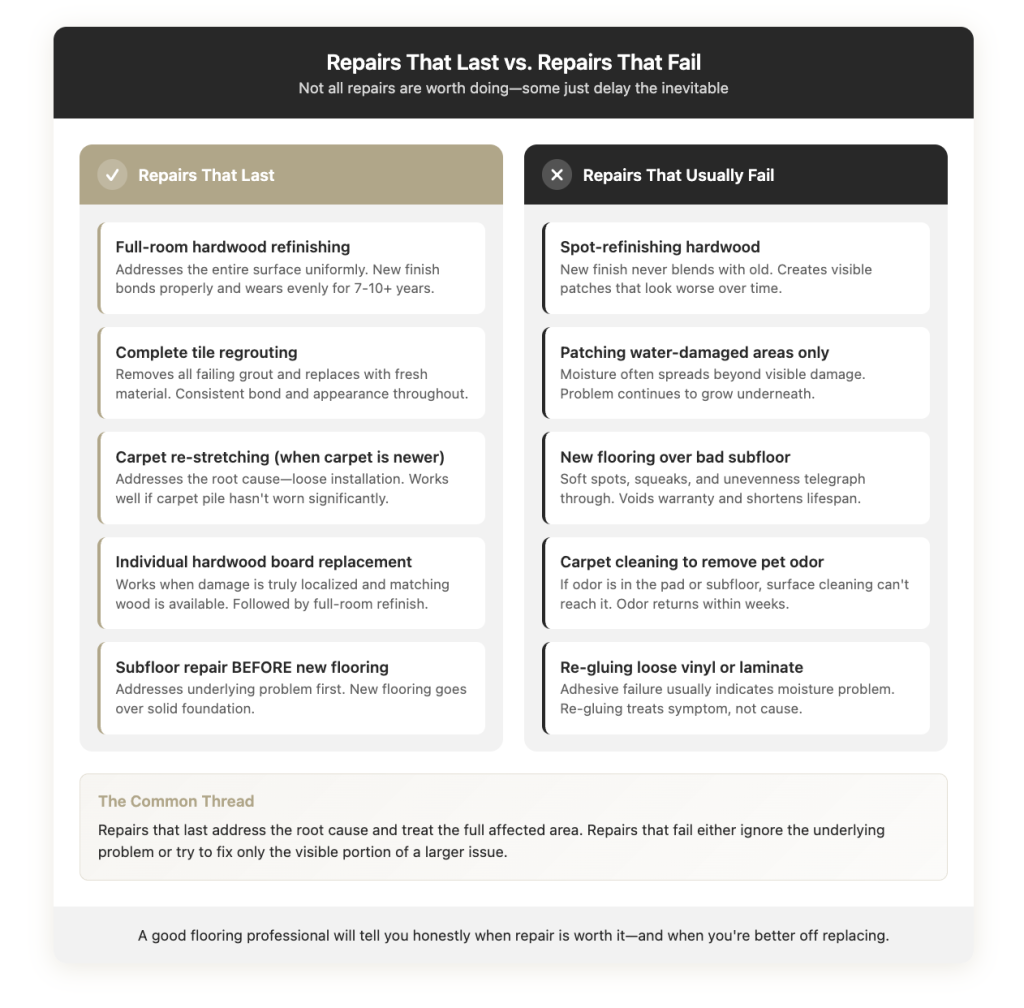
Not all repairs are equal. Some genuinely extend your floor’s life; others are temporary fixes that fail eventually.
Hardwood refinishing works exceptionally well. According to the National Wood Flooring Association, solid hardwood floors can typically be refinished 3-7 times over their lifetime. A full sand-and-refinish removes surface damage, scratches, and worn areas while creating an essentially new finish layer. This is one of the few repairs that truly “resets” flooring to like-new condition.
However, refinishing has limits. Floors that have already been refinished multiple times may have insufficient wood thickness remaining. Water-damaged boards that have cupped or warped beyond correction can’t be fixed by refinishing alone. And if the subfloor underneath is the problem, refinishing the surface is just cosmetic—the structural issues will return.
Spot repairs on tile can work. Replacing individual cracked or chipped tiles is practical if you have matching tiles available. Professional tile repair maintains the floor’s integrity without full replacement. Florida Tile’s maintenance guidance notes that proper grout sealing extends tile life significantly. The catch is color matching—new grout won’t match aged grout perfectly, and discontinued tile patterns are common.
Board replacement in hardwood is possible but tricky. Skilled installers can “weave in” new boards to replace damaged sections. This requires matching wood species, grain pattern, and finish. When done well, it’s virtually invisible. When done poorly, the repair is obvious. Understanding solid vs. engineered hardwood helps you know if board replacement is even possible for your floor type.
Carpet patching rarely looks right. If you have leftover carpet from installation, patches are technically possible. But seams show, color matching with aged carpet is difficult, and the patch often stands out. For visible areas, replacement usually produces better results.
Laminate and vinyl repairs are limited. These materials can’t be refinished. Individual plank replacement is sometimes possible with click-lock flooring, but getting replacement planks that match exactly—especially for discontinued products—is often impossible.
What Repairs Usually Fail?
Knowing what doesn’t work saves you money on futile attempts.
Cosmetic fixes over structural problems. If your floor is bouncing, sagging, or feels soft underfoot, that’s a subfloor or joist problem—not a flooring surface problem. No amount of surface repair fixes foundation issues. Flooring care guidelines emphasize that proper subfloor condition is essential for any flooring to perform correctly.
Refinishing water-damaged hardwood. Water causes hardwood to cup (edges curl up), crown (boards dome in the middle), or warp. These dimensional changes are permanent once the wood has expanded. You can sand a cupped board flat, but you’re removing wood from the edges—weakening the board and often exposing bare wood that won’t take stain uniformly. If water sits on your floors for more than 24-48 hours, replacement is usually the realistic option.
Sealing cracked grout without addressing movement. Grout cracks when the substrate underneath moves. Refilling cracked grout is a temporary fix unless you also address why the movement is happening. Otherwise, the new grout will crack in the same places.
Leveling out uneven floors with patch compounds. Self-leveling compounds can fix minor dips and waves, but if your subfloor is uneven because of structural settling or joist problems, the leveling compound just adds weight to an already stressed system. The floor will continue to move.
How Do I Evaluate My Specific Situation?
Before deciding, answer these questions honestly:
- What caused the damage? This matters more than most people realize. Damage from a one-time event (dropping something heavy, a single water incident that was addressed quickly) is different from damage caused by ongoing problems (moisture intrusion, subfloor movement, pet accidents over time). One-time damage can be repaired; ongoing causes must be eliminated first, or damage will recur.
- Is the damage isolated or spread out? One scratched board is a repair. Scratches throughout the house suggest the flooring can’t handle your household’s wear patterns—a bigger issue that replacement might address with a more durable material. Similarly, water damage in one spot is fixable; water damage across multiple rooms suggests a systemic moisture problem.
- What’s the flooring’s age and remaining life? A 5-year-old hardwood floor with surface scratches has decades of potential life remaining—refinishing makes obvious sense. A 25-year-old floor that’s been refinished twice already might only have one more refinish left, at which point you’re close to replacement anyway.
- Does the repair address the real problem? If your flooring shows signs of needing replacement—structural issues, extensive damage, or problems that keep recurring—repair might just delay the inevitable while costing money along the way.
- What will you gain from a replacement that repair won’t provide? Sometimes the honest answer is: nothing much. The floor works fine, the damage is minor, and the repair makes sense. Other times, replacement offers an upgrade—better materials, improved durability for your lifestyle, updated appearance. That upgrade value should factor into your decision.
Get a written estimate from Soleil Floors — no pressure, no surprises, just an honest number for your home.
Get a Free Estimate →What About Damage in High-Value Rooms?
Kitchen and bathroom flooring decisions often carry higher stakes because these rooms impact home value and daily living disproportionately.
Kitchen flooring takes serious abuse. Dropped items, water exposure from cooking and cleaning, heavy appliances, and constant foot traffic—kitchens test flooring durability more than any other room. When kitchen flooring is damaged, consider whether repair will hold up to continued abuse or whether it’s smarter to replace it with a more durable material. If you’re considering kitchen updates anyway, proper remodel planning should include a flooring evaluation.
Bathroom flooring must handle moisture. If your bathroom flooring shows water damage, the bigger concern is whether moisture is reaching the subfloor. Repairing or replacing surface flooring over a compromised subfloor just creates future problems. The EPA’s guidance on moisture and mold emphasizes addressing water sources before restoring surfaces.
Entryways and high-traffic areas wear fastest. Damage concentrated in these zones is normal wear, not necessarily a flooring failure. However, if the flooring in these areas is worn through while the rest of the house looks fine, you’re facing a decision: repair/replace just the high-traffic section (with transition and matching challenges) or replace the entire floor space for uniformity.
How Does Texas Climate Affect the Repair vs. Replace Decision?
Central Texas presents specific challenges that influence whether repairs will hold up.
Humidity swings stress repaired floors. Texas humidity varies significantly by season, and our aggressive AC use creates additional indoor swings. A repaired section that’s not perfectly matched or bonded can separate or show differential movement as the floor expands and contracts. The NWFA recommends maintaining 30-50% indoor humidity and 60-80°F temperature for wood floor stability—conditions that can be challenging to maintain consistently in Texas.
Concrete slab foundations and moisture. Most Austin-area homes sit on concrete slabs, and moisture can wick up from below. If your flooring damage relates to moisture intrusion, repair only makes sense after the moisture source is identified and eliminated. Otherwise, you’re repeating the same cycle.
Sun exposure accelerates wear. South-facing rooms and areas with significant sun exposure show finish degradation faster. If your floor damage is primarily UV-related fading and wear, refinishing can address it—but the same exposure will eventually cause the same damage. Consider UV-protective window treatments as part of your long-term solution.
For specific guidance on flooring that handles Central Texas conditions, understanding your home’s environmental factors helps you make better repair vs. replacement decisions.

What Should I Get Quotes For?
Before making a final decision, get professional assessments for:
The repair option:
- What exactly will be repaired and how
- What results can realistically be expected
- How long is the repair likely to last
- What happens if the repair fails
The replacement option:
- Full cost including tear-out and disposal
- Subfloor inspection and any needed prep
- Material options at different price points
- Timeline and disruption to your home
Both quotes should address:
- Whether underlying issues exist that need correction, regardless of surface choice
- What warranties or guarantees apply
- How the work will handle transitions to adjoining rooms
Getting both quotes helps you make an informed decision rather than guessing which option makes more sense.
What If I’m Planning Other Remodeling?
If you’re already considering kitchen, bathroom, or whole-house updates, that changes the calculation significantly.
Bundling flooring with other work often saves money. Contractors can often provide better pricing when combining projects. You also only disrupt your home once instead of multiple times.
Old flooring under new baseboards and cabinets creates complications. If you repair flooring now and remodel later, the new work will meet the repaired flooring. If you replace flooring later, you’ll be working around new cabinets and trim. Planning the sequence matters.
Avoiding common remodeling mistakes includes timing your flooring decisions appropriately with other home improvements.
Frequently Asked Questions
Spot repairs (fixing a few boards) might cost $200-$500. Full refinishing runs $3-8 per square foot. Replacement with new hardwood costs $8-15+ per square foot installed. The right choice depends on the extent—isolated damage often warrants repair, widespread wear warrants refinishing, and structural issues or severe damage usually require replacement.
Sometimes, but often not successfully. If water is cleaned up within 24-48 hours and the wood is dried completely without warping, refinishing may restore the floor. If boards have cupped, crowned, or show mold growth, those sections typically need replacement. The subfloor must also be inspected—water damage below the surface can’t be ignored.
Tile repair makes sense when damage is limited to a few tiles, and you have matching replacements available. Widespread cracking, loose tiles throughout, or hollow-sounding tiles when tapped indicate installation or subfloor problems that repair won’t fix. At that point, replacement addresses the underlying issue rather than just the symptoms.
It depends on the damage severity. Minor wear and dated appearance might not hurt your sale significantly, especially if you price accordingly. Obvious damage or flooring that looks neglected can reduce offers and extend time on market. Replacing damaged flooring with quality neutral options often provides good ROI. Repairing to “good enough” condition may work if buyers expect to update anyway.
Look for flooring contractors who offer both repair and installation services—they can give you honest assessments of both options. Be wary of contractors who only push one solution. For hardwood specifically, NWFA-certified professionals have demonstrated knowledge of repair and refinishing standards.
Not really. Unlike hardwood, these materials can’t be sanded and refinished. Minor scratches might be less visible with specific repair kits or markers, but the repair is cosmetic only. Deep scratches or gouges remain visible. Individual planks can sometimes be replaced in click-lock systems if you have matching replacement planks available—but discontinued products make this difficult.